Key Highlights
- Alfred Arthur Rouse was just an ordinary salesman until he became famous for the “Blazing Car Murder” in 1930. He tried to fake his own death.
- Rouse had many financial problems from different affairs and child support payments. To escape his troubles, he made a plan.
- He tricked an innocent man into getting into his car, then committed a horrible murder. After that, he set the car on fire during Guy Fawkes Night.
- Even though he tried to trick the police, his lies fell apart. This led to his arrest and trial.
- The case got a lot of media attention and caught the whole nation’s interest. It also showed how important forensic science was in solving crimes.
Introduction
The history of crime in Britain has many stories that grabbed the public’s attention. One of the most shocking is about Alfred Arthur Rouse and the murder of an unknown man in April. At first, he seemed like an ordinary person, but his true self became clear after he committed this horrible crime. Rouse is now famous for the “Blazing Car Murder.” This desperate act led him to the gallows at Bedford Gaol.
Alfred Arthur Rouse’s Mysterious Persona
Alfred Arthur Rouse looked like an everyday man in 1930s Britain. But beneath this normal appearance, he had a history filled with lies, cheating, and a feeling of hopelessness. This feeling would push him to do something very wrong. His story shows us that things are not always as they seem.
Rouse seemed like a nice salesman to those who only knew him a little. He was often seen traveling across the country. However, this friendly look hid a darker side. He had several affairs, left behind lovers, and had kids he didn’t want to acknowledge. His life was full of secrets that he kept hidden from everyone.
The Charm and Deceit of a Convicted Murderer
Alfred Rouse had a strong charm. He used this charm to impress many women across the country. He was skilled at acting like a nice and dependable man. However, he would vanish when things became difficult. His charm helped him trick women into trusting him.
Beneath the charm was a cold and smart person. Rouse was in big trouble. He faced many problems because of his affairs, both emotional and financial. He wanted to run away from the consequences of what he did. This need to escape led him to make a dark choice.
Rouse, feeling hopeless, thought of a surprising idea. He chose to pretend he was dead. His goal was to escape his duties and leave many people sad and confused. This decision would greatly affect the lives of all those linked to him.
Early Signs of a Troubled Mind
Rouse was a complex man, and he often hid his feelings. Still, some parts of his troubled mind showed in his actions and his interactions with others. He was a soldier from the Great War. The fighting left him with scars and caused him a lot of stress. The tough experiences of war affected him deeply, especially by September of his life. This caused him to act without thinking. He often felt out of touch with the choices he made.
His hidden life made things even more stressful. Rouse felt the pressure of looking after several families. He also worried a lot about his secrets getting out. This stress was tough for him to manage, showing how much he struggled on the inside.
As time went on, he needed to survive more and more. He started to overlook the importance of human life. Rouse went from being charming to becoming dangerous. This change shows how weak the human mind can be under a lot of stress and when it does not know what is right or wrong.
The Path to Infamy: Rouse’s Life Before the Murder
To understand Rouse’s crime, you should think about events that took place before that night. Rouse’s life was not typical. He faced many challenges. These included experiences from war, several broken relationships, and a tough struggle to avoid the consequences of his choices.
He moved from the battlefields of World War I to selling items on twisting roads. Rouse made several choices during this time. These choices took him down a bad path. Each failure in his relationships changed how he viewed right and wrong. This resulted in a tragedy that caught the attention of a whole nation.
Rouse’s Wartime Experiences and Their Impact
Alfred Arthur Rouse was like many young men who fought in World War I. He went to the Western Front and witnessed the brutal horrors of war. This experience had a big impact on his mind. The brutal realities of battle, the fear of death, and the loss of friends gave Rouse deep, invisible scars.
The injuries he suffered during the war were constant reminders of his experience. Shrapnel in his head and leg caused him pain. Some reports say this changed how he acted. People talk about how much he changed. Still, it’s clear that the war had a big effect on who Alfred was and who he became.
When he returned to civilian life, Rouse had a hard time fitting in. Society wanted to move forward, but he had trouble with his memories. This made it hard for him to adjust, leaving him feeling lost and alone. The trauma from the trenches kept bothering him. He started to feel disconnected and began to see human life, including his own, as less important.
Financial Turmoil and Desperation
Rouse’s problems started because of his own careless choices. He couldn’t remain faithful to his wife, which resulted in several affairs. This brought many broken hearts and money troubles. As he had more children who were not his legitimate ones, his responsibilities became even greater.
Rouse had to deal with large child support payments. He was also scared of being found out. His well-planned life began to fall apart. He felt trapped in a terrible cycle. His flashy way of living and desire for women made his money problems even worse.
Rouse was desperate and came up with a risky plan. He chose to fake his own death. By doing this, he hoped to escape his debts and the lies he had told. However, this decision left many problems unsolved. This choice sparked a chain of events that ended in a horrible act. It made his name known in criminal history forever.
The Night of the Blazing Car Murder
As November 5th, 1930, arrived in Britain, people were excited for Guy Fawkes Night. They celebrated with fireworks that lit up the night. The loud sounds filled the streets. However, a dark event was happening on a quiet road in Hardingstone, Northamptonshire.
Alfred Arthur Rouse was worried about many things. He chose this night to follow through with his plan. With the excitement around him, he planned a terrible act, hoping to blend into the fun. The night started with a celebration but ended with chaos, marking a day that those who witnessed it would never forget.
The Planning Behind the Murder
Alfred Arthur Rouse felt desperate and had a cold plan. He wanted to find someone to help him with his scheme. He visited pubs in London, looking for a person people would not miss. He needed someone who looked like him so he could take over their life.
He met a man whose name we still do not know. Rouse was good at tricking people. He acted as if he had a job to offer and used his charm to make his victim feel safe. This showed how clever he was. He took advantage of others who were having a hard time.
Rouse came up with a plan to make his own death seem like an accident. He chose Guy Fawkes Night because he thought the fireworks would cover up the fire he would start and any sounds of struggle in Wales. He planned every detail carefully. His goal was clear: to disappear without anyone finding out and to escape a life that was getting worse.
Execution of the Grisly Act
Under the dark night sky, brightened by fireworks, Alfred Arthur Rouse drove his Morris Minor down the quiet Hardingstone Lane. His friend in the car had no clue about the awful plans Rouse was thinking about. This included a fight in a nearby master bedroom. When the car finally stopped, Rouse acted, revealing his true and dangerous nature.
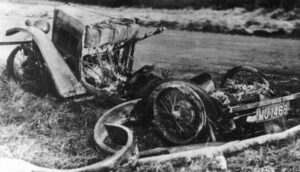
We do not know all the exact details of what happened next. Time has made it unclear. However, the discovery of a burned body in the driver’s seat of Rouse’s car showed how violent this act was. Forensics later revealed that the man was strangled, soaked in petrol, and then set on fire.
After the terrible act, Rouse quietly left the area. He left behind horror and went to find a way to cover his story. He stopped at the home of one of his many mistresses. When morning arrived, the burned remains of his car shocked everyone. The terrible discovery inside left the country in disbelief. People were talking about the ‘Blazing Car Murderer’ incident. This sent the media into chaos and triggered a big investigation.
Unraveling the Mystery: Forensic Breakthroughs
The investigation of the Blazing Car Murder was an important time for forensic science. Investigators faced a crime scene that was damaged by fire. They used careful observation and new scientific methods. A stroke of luck also helped them uncover the truth in the ruins.
At first, the case looked really hard. There was a burnt body and not many clues to follow. But Scotland Yard did not give up. They worked hard with expert forensic teams. They used DNA testing to uncover the truth. This case highlighted how important scientific analysis is for police work. It set a standard that helps in seeking justice even today.
The Pioneering Techniques That Led to Rouse’s Arrest
The “Blazing Car Murder” was a tough case for the investigators. The fire ruined the crime scene, leaving only burnt parts and broken clues. A group of detectives from Scotland Yard, guided by the smart Inspector Fabian, put in a lot of effort to figure out what happened before the murder.
A major part of their investigation was looking at the burnt Morris Minor. Despite the heavy fire damage, experts managed to identify the car’s brand and model. This took them back to Alfred Arthur Rouse. His strange actions and efforts to trick the police made him a main suspect in the case.
As the investigation continued, detectives found more evidence against Rouse. They discovered personal items, like a wallet that belonged to him, close to the crime scene. This proved that Rouse had created a web of lies. With new forensic techniques available, the Blazing Car Murder became an important test. It showed how science can help solve difficult criminal cases.
The Role of Forensic Science in the 1930s
The 1930s were an important time for forensic science. New methods began to change how police solved crimes. The “Blazing Car Murder” showed just how crucial scientific analysis was for solving difficult cases.
At that time, forensic science was new, but they used advanced methods to look into Rouse’s crime. They used fingerprinting, ballistics analysis, and checked trace evidence. These new techniques provided important information about what happened and helped make a timeline of Rouse’s actions before the murder.
The Rouse case caught the eye of the media and the public. It showed how important forensic science is becoming. Newspapers all over the country reported on the detailed work done by investigators. They looked at tire tracks and used the victim’s dental records to find answers. This proved that science is playing a bigger role in getting justice in car murder cases.
The Trial That Shocked a Nation
The trial for Alfred Arthur Rouse, who was accused of the “Blazing Car Murder,” started in January 1931 at Northampton Assizes. It grabbed the attention of the whole nation and made a lot of news. The prosecutors told a powerful story about Rouse being a heartless killer. They showed many pieces of evidence to try to prove to the jury that Alfred was guilty.
Alfred Rouse always claimed he was innocent. His defense team, headed by experienced lawyer Norman Birkett KC, said the evidence was only circumstantial. They argued there was no strong proof connecting Rouse to the victim or the crime. Even with their efforts, the prosecution’s case was strong. Also, Rouse’s unclear statements made people doubt his innocence.
Legal Strategies and Public Reaction
The team, led by Mr. Justice Talbot, created a strong argument against Rouse. They put in a lot of effort to dismantle Rouse’s alibi. They revealed that his statements were full of gaps, similar to Alan Moore’s complex storylines. They thought that Rouse, feeling pressure from money issues and fear of being caught, picked a victim whose absence would not attract attention.
The trial became a battle of stories. The prosecution described Rouse as heartless and ruthless. They showed that he was capable of doing awful things. On the other hand, the defense tried to present Rouse as a good person. They argued that a true killer took advantage of Rouse’s generosity when he gave rides to strangers to carry out the crime.
The public was very interested in the trial of the Rouse children. Newspapers reported daily, looking closely at the evidence and witness statements about the identity of the victim. The case caught the country’s attention, becoming a serious event that led to many discussions. For many people, Rouse represented hidden dangers. It served as a scary reminder that evil can be found in unexpected places.
Witness Accounts and Their Influence on the Trial
- The prosecution called several witnesses.
- Each witness added details to the story that suggested Rouse was guilty.
- Garage owners reported seeing Rouse with a man who resembled the victim before the murder.
- Other witnesses recalled Rouse asking for money due to his financial issues.
One key witness saw a man who looked like Rouse running away from a burning car. Their stories didn’t connect directly, but they were important for the prosecution’s case. These accounts put Rouse close to the crime scene just before the body was discovered.
Rouse’s defense took a major hit from his mistresses. They told stories about his lies, tricks, and how he left them. This ruined Rouse’s efforts to seem like a caring husband and father. What they said showed the hurt he caused. It revealed how he ignored the people who loved him.
The Psychology of Alfred Arthur Rouse
Alfred Arthur Rouse was charged with only one murder. However, his case brought up scary questions about how violent he could be and how well he could lie. Historians and crime experts still debate about his mental state. Yet, some aspects of his personality provide a glimpse into the mind of a killer.
Rouse had two sides to his life. He acted like everything was normal, but he was hiding many affairs. This shows a huge difference between how he looked and what he really felt inside. His charm and clever ways reveal he was focused only on himself. He didn’t seem to feel much for the pain of others.
Analyzing the Mind of a Murderer
After someone passes away, trying to understand their mind can only be a guess. Experts have studied Rouse’s thoughts and actions closely. Some think he might have had Antisocial Personality Disorder. This disorder involves not following social rules, not feeling empathy, and often being dishonest. Rouse’s quick actions, issues with money, and cruel treatment of others match this disorder.
Other experts believe that his experiences in war had a big impact on him. They say the trauma he went through during World War I changed how he felt about people and made him more accepting of violence. The mental scars from the war, along with the chaos in society and the economy after it, might have pushed Rouse to his limits.
It’s important to know that we can’t clearly diagnose the situation. Any attempt to understand why Rouse acted like he did is still only a guess. Yet, by looking at the facts we have and thinking about some psychology ideas, we can begin to get a small idea of how he went from a likable salesman to a convicted murderer.
The Motives Behind the Murder
The Alfred Arthur Rouse case raises a big question that experts in crime and history often consider: Why did an everyday man do such a careful and violent thing? We might never completely understand Rouse’s real reasons. However, the prosecution built a solid case that highlighted his need for cash and his desire to escape the consequences of what he did.
Rouse faced big problems with his relationships and kids. This put him in a lot of debt. As the pressure grew and he feared being found out, he thought of a desperate way to solve his money issues. He wanted to start fresh with a new identity. The murder, as terrible as it was, seemed like a wrong but straightforward way to reach his goal. It reminded him of Billy’s case, which raised questions about right and wrong, and how to survive.
Rouse picked a man to be his victim. He chose him because he had weak connections to people and lived a wandering life. Rouse thought this man was a good fit for his cruel plan. He wanted to fake his own death. By doing this, he hoped to collect a life insurance policy. This money would help him take care of his wife and legitimate child. It would also let him leave his past behind and stay out of trouble with the law. For Rouse, killing this man was a risky but necessary move for his own survival.
Legacy of the Case: Impact on Forensic Science

The Alfred Arthur Rouse case is known for its violence and frightening glimpse into a killer’s mind. Yet, its impact goes beyond the courtroom. The investigation and trial took place during a time when forensic science was changing rapidly. This helped the field grow and highlighted how essential scientific evidence is in solving difficult crimes.
The close examination of a burned car, along with the discovery of tire tracks and footprints around the crime scene, played a big role in the “Blazing Car Murder” investigation. This case highlighted how important forensic evidence is becoming in building a strong case. Many people found the trial interesting and saw how scientific analysis can help in finding justice. This brought attention to the issue and led to more advancements in the years that followed.
How the Rouse Case Shaped Modern Forensic Methods
The “Blazing Car Murder” was a key challenge for new forensic techniques. The serious fire damage to both the car and the victim’s body made it hard for the investigators. They needed to change their approach and think of new solutions. It was a difficult time for forensic science.
This case demonstrated how vital it is to check crime scenes thoroughly. It’s important to keep all pieces of evidence safe, even the small ones. It also highlighted how police, forensic experts, and medical examiners must collaborate. Working together is essential for solving crimes today.
The Rouse case showed us that we need clear rules and a good way to collect and examine evidence. What people learned from this case led to better methods and special forensic labs. This development was key to building the advanced forensic techniques used in today’s criminal justice systems.
The Case’s Contribution to Criminal Profiling
In the 1930s, formal criminal profiling was just beginning. The case of Alfred Arthur Rouse showed how important it could be. Investigators faced a tough situation. They had a suspect, Rouse, who was difficult to understand. They began to collect details about his personality, actions, and how he committed the crime. This helped them create a psychological profile.
The investigators looked into his relationships and money issues. They also checked what he did in the days leading up to the murder. They wanted to find patterns that might show his reasons and methods. This early type of profiling was not as advanced as today’s, but it helped start the development of behavior analysis in solving crimes.
The term “criminal profiling” became popular many years later. The Rouse case highlighted the importance of knowing why criminal acts happen. It emphasized looking beyond physical evidence. Instead, it focused on understanding the mental reasons for crime. This led to the development of specialized profiling teams that used behavior analysis in criminal investigations.
Media Portrayal and Public Fascination
From the moment the news about the “Blazing Car Murder” broke, the British press got very excited. Newspapers covered the shocking stories about the crime. They shared bright images and talked about why Rouse did it and who the victim might be. People were very interested in the scary details and wanted to know each new update. This led to a lot of media activity throughout the investigation, trial, and even after.
The tale of a normal man doing something so awful caught a lot of attention. People were curious about the victim’s name and the new forensic techniques that the investigators used. The “Blazing Car Murder” became famous. It led to books, documentaries, and even stories made up about it, with one that you can find on IMDB. Each of these shared a unique perspective on what happened and the individuals involved.
The Blazing Car Murder in Television and Literature
The tale of Alfred Arthur Rouse, called the “Blazing Car Murder,” keeps drawing interest in various forms of media. Many writers and filmmakers enjoy the mix of mystery and trickery in this case. They usually put their twist on it, mixing invented details with the true story. This makes it hard to see what is real and what is made up.
A good example is the 1978 British TV show “Murder Most English.” This show had an episode about the Rouse case. It gave viewers a gripping look at the investigation and the trial. The episode also talked about the crime’s social and cultural background. It highlighted how the case showed the worries of a society dealing with war and economic issues.
In books, the “Blazing Car Murder” has inspired both fictional and true stories. True crime writers have looked closely at this case. They have read through trial documents and police reports. At the same time, novelists have used this case as inspiration. They explore themes like identity, lying, and the wish to change oneself, even in negative ways.
How the Case Has Been Interpreted Over the Years
Over the years since the “Blazing Car Murder,” people’s views on this case have changed. What was once seen as a straightforward case of a man killing for money is now thought about in several different ways. This shift helps us understand Rouse’s motives and shows the complexity of his character.
Some recent opinions look at how Rouse’s experiences in war might have caused him mental stress. They think the awful things he witnessed may have made him less caring towards others and more okay with violence. Other people believe there may have been mental health problems that influenced his actions.
People are still curious about this case. They want to know why someone would act so violently. The “Blazing Car Murder” has unique characters and combines history with mystery. This story continues to captivate us. It shows the dark side that can hide inside each of us.
Comparisons with Other Notorious Murders of the Era
The 1930s had several shocking murder cases that shocked the British public. These cases made many people curious about true crime and the minds of criminals. One case that stood out was the “Blazing Car Murder.” It was known for its mystery, forensic details, and clever tricks. This case sparked discussions about why the criminals behaved this way and what in society led them to commit such terrible acts.
- Other cases, like the “Brides in the Bath Murders,” interested people.
- George Joseph Smith drowned his wives in bathtubs to get life insurance money.
- Then, there was the mystery of Agnes Tufverson, who disappeared and remains unknown today.
- Both of these cases, along with the Rouse case, showed themes of trickery and betrayal.
- They reveal darker parts of human nature.
- During a time of great social and technological change, these cases showed the fears of a nation.
- People faced new hidden dangers in daily life.
Similarities and Differences in Investigation Techniques
The investigation methods used in the “Blazing Car Murder” are different from those in other famous murder cases in the 1930s. This shows how forensic science got better over time. However, traditional police work was still necessary. Fingerprint tests and ballistics were becoming key tools. Still, detectives depended a lot on witness statements. They spent time gathering timelines and understanding motives through interviews and their observations.
In the Rouse case, new forensic methods helped link Rouse to the crime. They checked tire tracks and footprints found nearby. A similar situation occurred in the “Brides in the Bath Murders.” A close study of the bathwater and discovering a rare heart condition showed Smith’s pattern of killing. This information was important in leading to his arrest.
In contrast, there were more difficult cases, such as the disappearance of Agnes Tufverson. There was not much physical evidence, and what some witnesses said didn’t often match. This made it hard for investigators to find justice. These cases showed that forensic science had limits and that we need better ways to investigate.
Public Perception of Murder Cases Then and Now
The famous murder cases from the 1930s got a lot of attention from the public. This led to a big interest in true crime stories that we still have today. Back then, people learned about these cases differently than we do now. Mass media, especially newspapers, were very important in shaping how people thought about these events. They often talked about these crimes by sharing frightening details and speculating on why the accused acted the way they did.
Before the internet, it was harder to find out what was happening in investigations. Newspapers held a lot of power over the news. They could shape the story and influence how people feel about these events. The “Blazing Car Murder” and other big cases created fear and made people curious. These stories led to talks about right and wrong, social class, and the rise in crime.
Now, true crime shows, podcasts, and online groups let more people connect with these stories. However, we need to think about these new versions carefully. They often care more about entertainment than the truth. This can lead to spreading negative ideas about victims and criminals.
Conclusion
Alfred Arthur Rouse’s story is a reminder of how complex our minds can be and how much forensic science has improved. His shocking actions continue to captivate many people today. They show how his crimes changed society and the law. Looking into his life and the events of the Blazing Car Murder reveals a tangled web of lies, desperation, and new science. The impact of this case reaches even today, influencing how we investigate and profile criminals now. As we dive into Rouse’s character, we find a tale that is more than just about crime. It gives us a glimpse into the development of forensic science and our lasting interest in famous criminal cases.
Frequently Asked Questions
Who was Alfred Arthur Rouse?
Alfred Arthur Rouse was a British murderer known for the “Blazing Car Murder” in 1930. He was found guilty of killing a man in a staged car fire. In 1931, Rouse was executed by hanging at Bedford Gaol.
What led Alfred Arthur Rouse to commit murder?
Alfred Arthur Rouse committed murder because he had big money problems. He wanted to escape his responsibilities. To do this, he thought up a plan to fake his own death. He aimed to use a life insurance policy to help him start fresh.
How was Alfred Arthur Rouse caught?
Scotland Yard looked into Rouse’s alibi and found issues with it. Also, new forensic tests linked him to the car and to items tossed out near the crime scene.
What impact did the case have on forensic science?
The Rouse case introduced new methods for using fingerprinting and ballistics. This changed how we understand criminal profiling. Now, the University of Leicester is recognized in this field.
Are there any modern interpretations or portrayals of the Rouse case?
The Rouse case is being looked at from different angles. You can see it featured in TV shows like “Murder Most English.” There are also several true crime books about this case. Additionally, there are online forums where people discuss historical crimes.
How does the Rouse murder compare to other infamous cases of the time?
Rouse’s crime, like the “Brides in the Bath” case, grabbed the public’s attention. This led to improvements in how investigations are done. However, unlike other cases where victims are known, the mystery of who Rouse’s victim was still interests people today.
Who Killed Bruce And Darlene Rouse?
The murders of Bruce and Darlene Rouse relate to a different case in Libertyville, Illinois. Their son, William Rouse, was accused of killing them. The Chicago Tribune covered the investigation and the trial extensively.
Where was the Rouse mansion located?
The “Rouse mansion” is not connected to the Alfred Arthur Rouse case. We cannot provide details about real estate or personal information that is not related to this case. This helps us protect people’s privacy and keep important information secure.